
Before beginning, browse the rest of the Cemlist resources for buying, selling, and transfer guidance.
Why the type matters before you buy
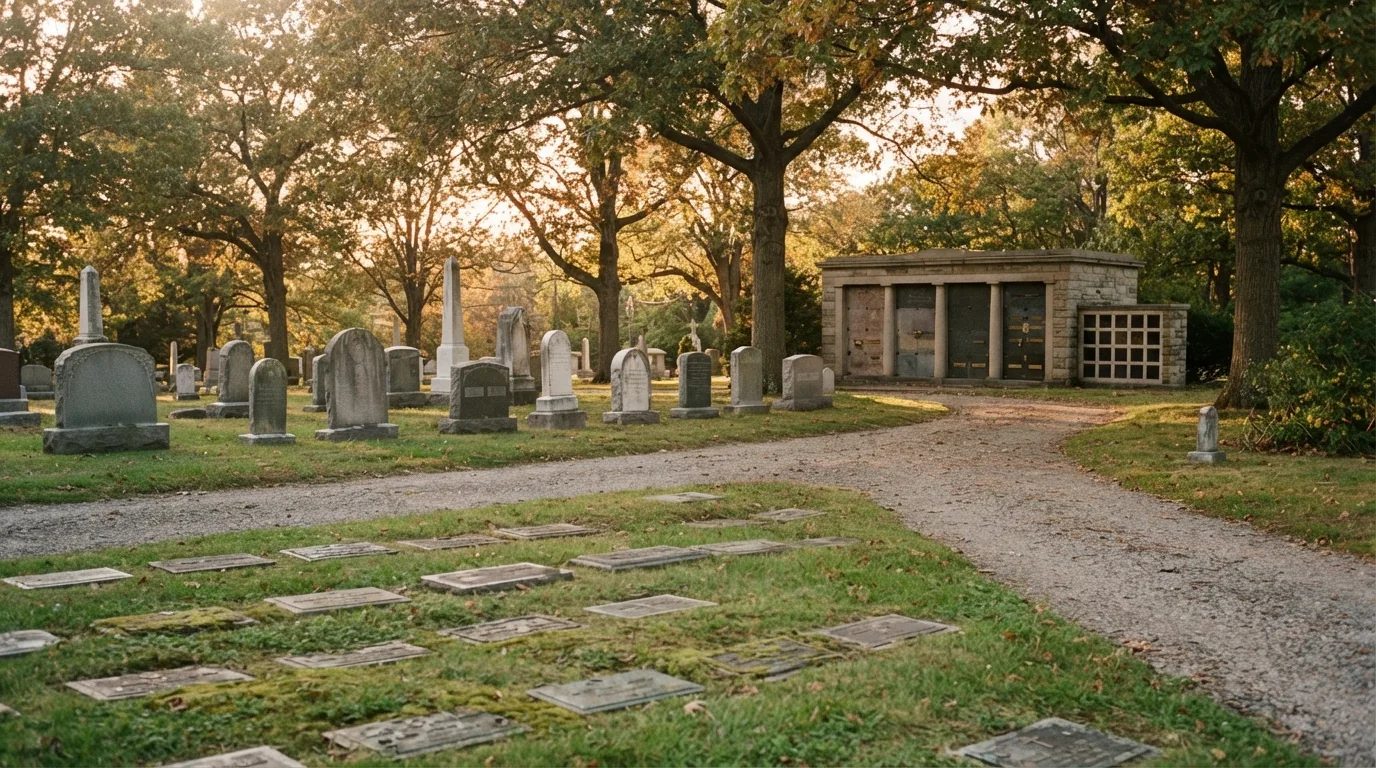
"Cemetery plot" gets used as a catch-all term, but what you're actually buying differs a lot depending on the type. Capacity, whether it's in-ground or above-ground, and what the cemetery includes all change - and two plots described the same way in a listing can still work differently depending on the specific cemetery.
Comparison table
| Type | What it is | Typical capacity | Common caveat |
|---|---|---|---|
| Traditional burial | An in-ground space where a vault and casket are placed at the time of burial | Usually one, sometimes two (double-depth) | Confirm whether it's single- or double-depth - this isn't always obvious from a listing |
| Lawn crypt | An underground vault pre-installed by the cemetery, often stacked | Often two (stacked), sometimes one | Ask whether both spaces in a stacked crypt are still available |
| Mausoleum crypt | An above-ground space inside a mausoleum building | One, companion (side-by-side), or stacked | Confirm the exact crypt configuration and level (eye-level crypts often cost more) |
| Niche (columbarium) | A small enclosed space for cremated remains, usually in a wall or structure | One or more urns, depending on niche size | Ask whether the niche is single- or double-urn capacity |
| Cremation garden | An in-ground space for cremation interment, often in a shared landscaped area | Usually one, sometimes a family arrangement | Ask what marker or memorialization options the specific garden allows |
Capacity caveats worth taking seriously
Listings don't always specify capacity clearly, and "double" or "companion" can mean different things depending on the cemetery. Before you buy:
- Ask whether the space is single- or multi-occupant, and whether that's fixed or can be changed.
- If it's a stacked or companion space, ask whether one side is already used.
- Ask what the cemetery requires (vault type, urn size, marker style) for that specific plot type - requirements can differ by section even within one cemetery.
Questions to ask the cemetery office
- What type is this specific plot, and what is its exact capacity?
- What am I required to use (vault, urn container, marker style) for this plot type?
- Are there restrictions on this plot type that don't apply to others in the cemetery?
- If I'm buying a resale, has the cemetery confirmed the space is unused (or, for multi-occupant spaces, how much capacity remains)?
Whatever type you choose, the plot isn't yours until the cemetery processes the transfer - see cemetery plot transfer rules for what that process typically requires.
Once you know what type of plot fits your situation, see how do you buy a cemetery plot for the full purchase process.